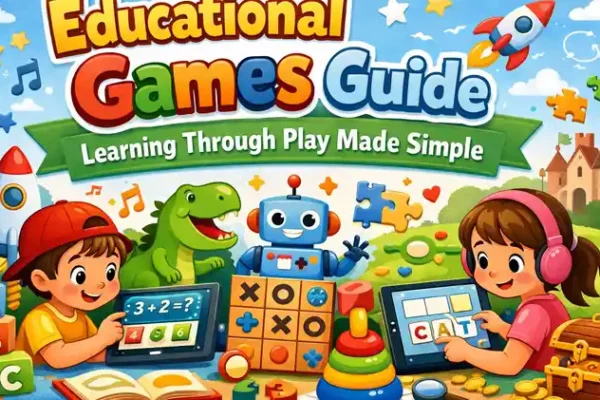
Educational Games Guide: Learning Through Play Made Simple
Want to make learning fun? Educational games can help. These games mix play with learning.…
1 article
 Education
Want to make learning fun? Educational games can help. These games mix play with learning.…
Educational games have revolutionized the way we approach learning, blending entertainment with knowledge acquisition in powerful ways. These interactive tools transform traditional education into exciting adventures that captivate learners of all ages. From alphabet games for toddlers to complex strategy simulations for professionals, educational games offer something valuable for everyone.
The beauty of educational games lies in their ability to make learning feel like play. This unique approach eliminates the anxiety often associated with traditional education, creating a relaxed environment where mistakes become learning opportunities rather than failures. Players naturally develop problem-solving skills, critical thinking abilities, and subject matter expertise while enjoying themselves.
In this comprehensive guide, we will explore the world of educational games, examining their benefits, popular categories, and how to choose the right games for different age groups and learning objectives. Whether you are a parent looking to supplement your child’s education, a teacher seeking innovative classroom tools, or an adult wanting to learn new skills, this article will provide you with the insights you need to make informed decisions about educational games.
The Benefits of Educational Games
Enhancing Cognitive Development
Educational games stimulate brain activity and promote cognitive growth in remarkable ways. Memory games improve recall and retention capabilities. Puzzle games develop logical reasoning and spatial awareness. Language games expand vocabulary and strengthen communication skills.
Research consistently shows that game-based learning enhances engagement and information retention. The interactive nature of educational games requires active participation, which helps learners develop deeper understanding of concepts compared to passive learning methods. Players must think, analyze, and make decisions, creating neural pathways that strengthen cognitive functions.
Furthermore, educational games often incorporate adaptive difficulty levels that challenge players at appropriate rates. This customized approach ensures learners remain in the optimal zone of difficulty, avoiding boredom while preventing frustration. The result is sustained motivation and continuous improvement.
Building Social Skills Through Play
Many educational games incorporate multiplayer features that foster social interaction and collaboration. Players learn to communicate effectively, negotiate solutions, and work toward common goals. These experiences develop teamwork abilities and emotional intelligence that prove valuable in real-world situations.
Competitive educational games teach healthy competition, good sportsmanship, and how to handle both victory and defeat gracefully. Players learn that effort leads to improvement and that setbacks provide valuable learning opportunities. These life lessons extend far beyond the game environment.
Additionally, online educational games connect learners from around the world, exposing them to diverse perspectives and cultures. This global connectivity broadens horizons and promotes cultural understanding while providing opportunities for international collaboration and friendship.
Popular Types of Educational Games
Language and Literacy Games
Language-focused educational games help players develop reading, writing, and speaking skills through engaging activities. Word games expand vocabulary and improve spelling abilities. Story creation games encourage creative expression and narrative thinking. Grammar games make learning language rules enjoyable and memorable.
These games prove particularly effective for language learners and children developing literacy skills. The gamified approach removes the tedium from language practice, encouraging extended engagement that leads to measurable improvement. Many language apps use spaced repetition systems that optimize memory consolidation.
Math and Logic Games
Mathematical games transform numbers and equations into exciting challenges. Addition and subtraction games make basic arithmetic fun. Algebra games introduce abstract concepts through visual representations. Logic puzzles develop reasoning skills that transfer to many academic and professional domains.
The interactive nature of math games allows for immediate feedback, helping learners identify and correct mistakes in real-time. This instant validation accelerates learning and prevents the formation of misconceptions. Many educational math games incorporate storylines that contextualize mathematical concepts, making them more meaningful and memorable.
Science and Discovery Games
Science games bring complex concepts to life through interactive simulations and experiments. Biology games explore ecosystems and anatomy. Chemistry games simulate reactions and compound formations. Physics games demonstrate forces and energy concepts through hands-on activities.
These games allow learners to experiment safely, observing cause-and-effect relationships without real-world risks. Virtual laboratories enable exploration of topics that would be impossible or dangerous to study in traditional settings. The freedom to make mistakes and try again encourages scientific curiosity and inquiry.
Choosing the Right Educational Games
Age-Appropriate Selection
Selecting educational games appropriate for the player’s developmental level is crucial for maximizing benefits. Younger children benefit from simple, colorful games with straightforward mechanics. Older children can handle more complex rules and abstract concepts. Adults often prefer games that offer practical skill development or professional advancement.
Consider the player’s attention span, reading level, and motor skills when choosing games. The best educational games grow with the learner, offering advanced levels and new challenges as skills improve. This progression maintains engagement and provides continued value over time.
Learning Objectives Alignment
Different educational games emphasize different skills and knowledge areas. Identify specific learning goals before selecting games. Some games focus on academic subjects like math or science. Others develop soft skills like creativity, communication, or critical thinking.
Read reviews and educational standards alignment information when evaluating games. Many educational games come with detailed descriptions of the skills they develop and the age groups they target. This information helps match games to specific learning objectives.
Conclusion
Educational games represent a powerful tool for making learning enjoyable and effective. Their ability to engage learners, provide immediate feedback, and adapt to individual needs makes them invaluable supplements to traditional education. From young children taking their first steps in learning to adults seeking professional development, educational games offer pathways to knowledge that feel like play.
The key to success lies in selecting appropriate games and using them effectively. Consider age, learning objectives, and individual preferences when making choices. Combine educational games with other learning approaches for comprehensive skill development.
As technology continues advancing, educational games will become even more sophisticated and accessible. Embracing these tools today prepares learners for tomorrow’s challenges while making the journey of learning genuinely enjoyable. Start exploring educational games today and discover the fun that learning can be!
Subscribe for exclusive tech updatearticle insights, articles, and tips delivered to your inbox. No spam, ever.
🔒 We respect your privacy. Unsubscribe anytime.